What would it take to watch an electron move through a material? Researchers would need to see individual atoms and capture an electron’s motion at incredibly short timescales. A Technion-led team has brought those two capabilities together in a scanning tunneling microscope, using carefully shaped laser pulses to control the direction of electron flow while preserving nanoscale spatial resolution.
The study, led by Prof. Michael Krüger of the Technion Faculty of Physics and published in Nature Photonics, builds on a microscope with an exceptionally sharp needle tip. When the needle tip is brought very close to a surface, electrons can cross the gap through a quantum effect called tunneling. The resulting current flow lets researchers map minute features of the surface. Until now, following the rapid movement of electrons within that tiny gap has been a major challenge.
The team directed infrared laser pulses into the gap between the tip and the sample. Each pulse contained two colors of light. By changing their relative timing, the researchers changed the shape of the light wave – and could steer electrons from the needle tip to the sample or back in the opposite direction. They adjusted the timing instead of repeatedly turning the laser on and off, helping them distinguish the ultrafast current from noise signals caused by laser heating.
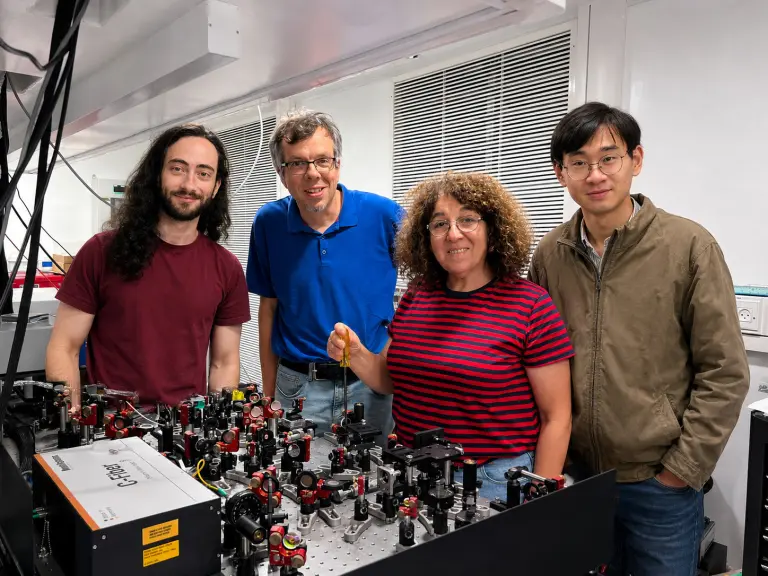
“I fondly remember the day when our students Daniel Davidovich and Boyang Ma and Dr. Adi Goldner came to my office with a new and exciting measurement,” said Prof. Krüger. “We could finally prove without any doubt that we can control the direction of the current.”
Read more
In the illustration Laser pulses from the left (shown in two colors) strike the needle, while electron currents (shown in green) flow between the needle tip and the sample